English Proficiency Enforcement Is Back: What Truck Drivers and Carriers Should Prepare For
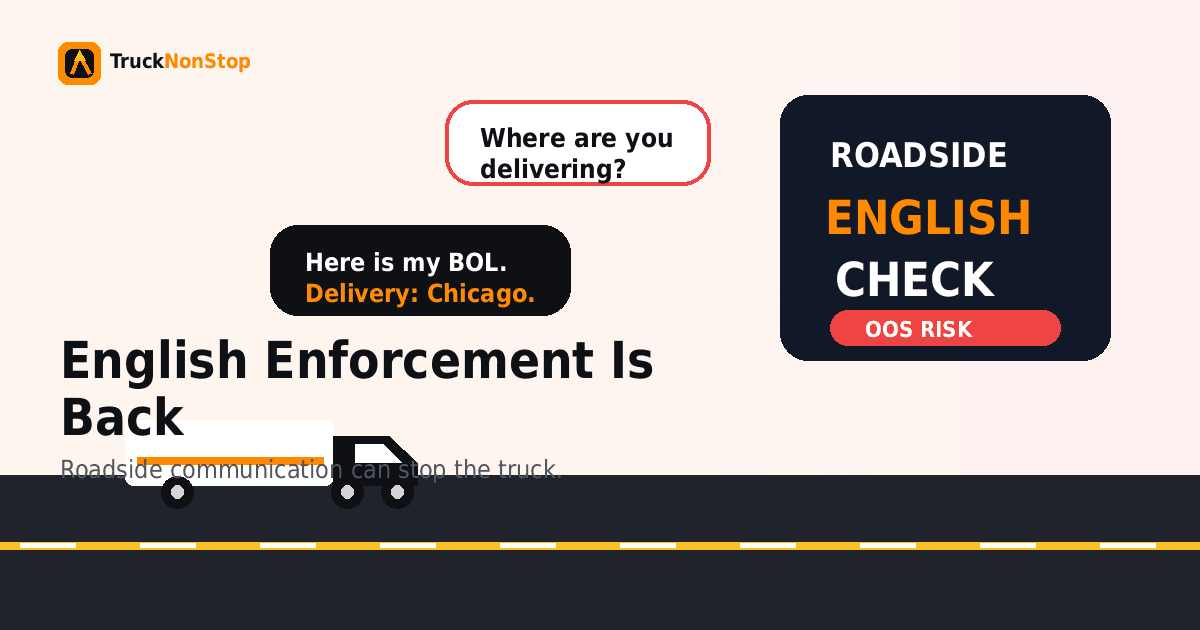
English proficiency has moved from a background regulation to a front-line trucking issue.
The Commercial Vehicle Safety Alliance announced that effective June 25, 2025, non-compliance with the federal English-language proficiency requirement became a driver out-of-service violation under the North American Standard Out-of-Service Criteria. CVSA said drivers who cannot satisfy the requirements of 49 CFR 391.11(b)(2), according to FMCSA enforcement guidance, will be declared out of service.
For drivers, dispatchers, and small carriers, this is no longer just a licensing topic. It is a roadside inspection, safety, and business-continuity issue.
What the rule is trying to test
The rule is not asking every driver to speak perfect English. The practical concern is whether a commercial driver can communicate with law enforcement, read highway signs, understand inspection instructions, explain origin, destination, load, and documents, respond during emergencies, and complete basic required communication.
A driver who cannot communicate during a roadside stop can be placed out of service.
Why this matters to North American trucking
This issue is especially important in cross-border and immigrant-heavy trucking communities. Many hardworking drivers from Punjabi, Spanish-speaking, South Asian, Eastern European, and other backgrounds run freight safely every day. But enforcement pressure means carriers can no longer assume “experience is enough.”
A driver may be skilled behind the wheel and still face trouble if communication fails during inspection.
What carriers should do now
1. Add a job-related English communication check during hiring
Keep it practical. Do not turn it into an unfair or discriminatory process. Focus on job-related communication: roadside questions, signs, shipping documents, and officer interaction.
2. Train with real roadside phrases
Drivers should practice phrases like: “I am hauling refrigerated freight,” “My pickup was in Dallas and delivery is in Chicago,” “Here is my license, medical card, registration, insurance, and BOL,” “My ELD is here,” and “I need clarification. Can you repeat that, please?”
3. Keep documents organized
When communication is difficult, organized paperwork helps. A messy permit book makes every inspection worse.
4. Do not rely on the dispatcher
During a roadside inspection, the driver is the one standing there. The dispatcher may not be able to rescue the situation.
5. Build a 30-day driver English plan
A trucking-specific English plan should cover road signs, inspection vocabulary, shipping documents, emergency phrases, HOS and ELD vocabulary, police/scale house communication, and border-crossing terms.
What drivers should not do
Do not argue. Do not panic. Do not pretend to understand if you do not. Do not hand the phone to someone else as your only way to communicate.
A better phrase is: “Officer, I understand some English. Please speak slowly. I will answer.”
Why this topic belongs on TruckNonStop
TruckNonStop should build a free Truck Driver Roadside English Guide with audio: 100 inspection phrases, 50 signs and meanings, 25 ELD phrases, 25 border phrases, Punjabi/Hindi/Spanish support pages, a practice quiz, and a printable cab sheet.
Bottom line
English enforcement is not about writing essays. It is about roadside survival. For drivers, the goal is simple: understand, respond, and keep the truck moving legally. For carriers, the goal is even clearer: do not lose a load because nobody prepared the driver for a five-minute conversation.
Research sources
- CVSA English Proficiency OOS Notice: https://cvsa.org/news/elp-oosc-06252025/
- FMCSA ELP Guidance Page: https://www.fmcsa.dot.gov/registration/commercial-drivers-license/cvsa-training-committee-meeting-september-2025-faqs-0
- ATRI Top Issues Summary via Land Line: https://landline.media/freight-recession-hits-home-in-latest-atri-survey/
Put this into practice
Run your next load through the numbers and check the broker before you book.